An authentic Berber rug is at once a useful object, a textile work, and a testament to craft passed between generations. Each piece has its own nuances, rhythm, and small irregularities. To choose a rug that will accompany you for a long time, you must look beyond the pattern alone.
Comprendre les grandes familles de tapis
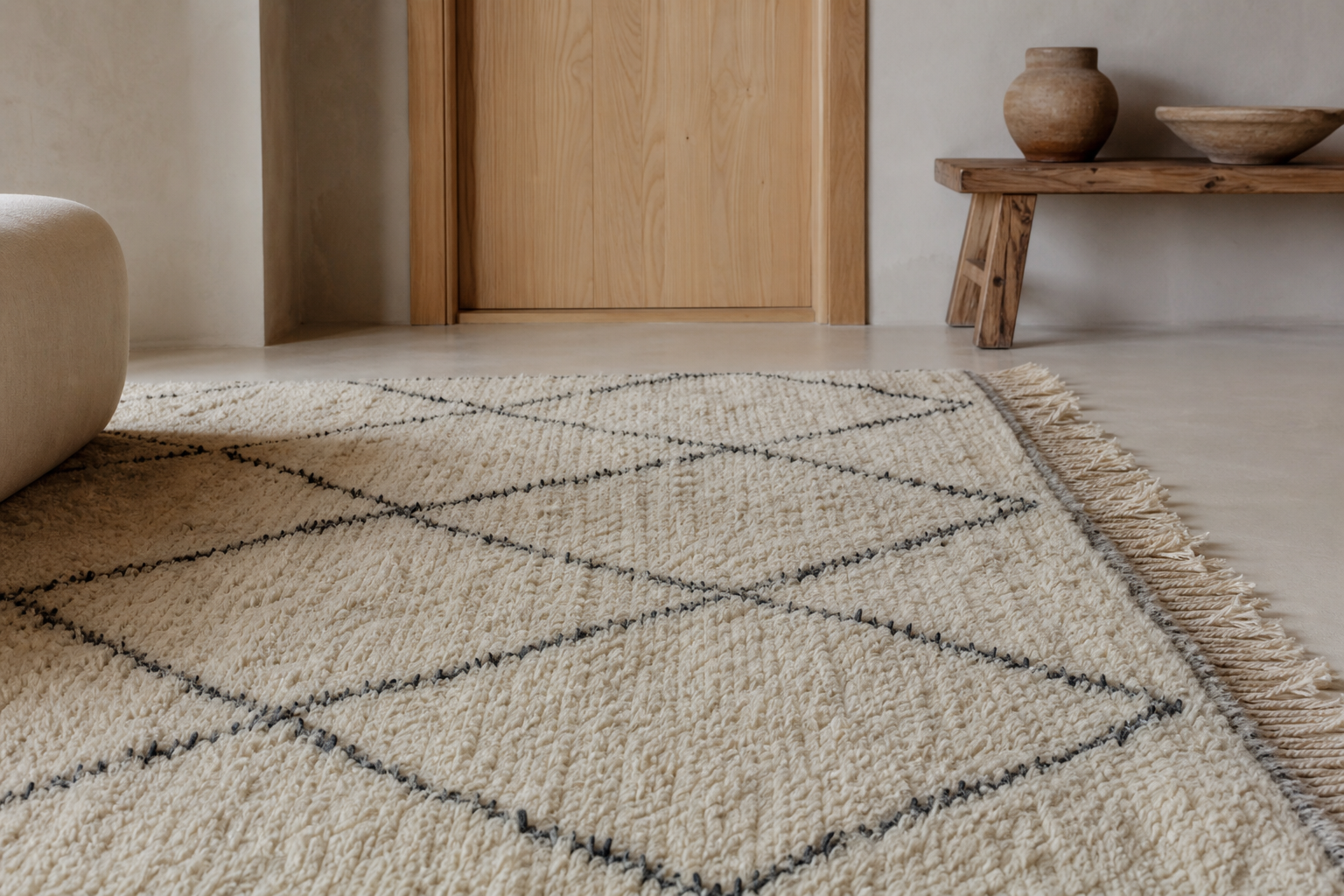
The Beni Ouarain is known for its thick wool, often natural cream, punctuated by dark geometric lines. The Azilal frequently pairs a light base with freer, more colorful motifs. The Boucherouite, made from reclaimed textiles, offers a lively and singular composition. Flat-weave rugs, or kilims, are lighter and more practical in an entryway or under a table.
These names describe traditions and regions, but each weaver interprets the patterns in her own way. Two rugs should therefore never be perfectly identical.
Examining the material and knotting
Natural wool offers a supple texture, particular warmth and slight variations in color. Gently part the fibers to observe the rug's base. Hand-knotting is not perfectly uniform: this variation is normal. Also check the edges and fringes, which should be an integral part of the structure rather than simply sewn on.
Choosing the right size
In a living room, measure the seating area and ideally let the rug extend under the front legs of the sofa and armchairs. In a dining room, allow about 60 cm of extra rug on each side of the table so chairs stay on the rug when pushed back. In a bedroom, a large rug under the bed brings comfort and cohesion, while two bedside runners suit smaller spaces.
Observing the colors in your room
Natural light changes how wool looks throughout the day. An ecru rug warms up a gray or mineral floor. Red and orange tones energize a neutral room, while blue or green create a fresher feel. Also consider the colors already present in your curtains, cushions and wall art.
Recognizing the signs of handmade work
- The pattern may show small asymmetries.
- The knot density varies slightly.
- La laine n’a pas un aspect excessivement brillant ou plastique.
- The seller indicates the origin, material and method of manufacture.
A strong chemical smell or repetitive mechanical perfection should prompt you to ask for more information.
Caring for a Berber rug
Vacuum it gently, without an aggressive rotating brush, and rotate its orientation a few times a year to balance sun exposure and foot traffic. In case of a spill, blot immediately without rubbing. For a deep cleaning, consult a professional experienced with handcrafted wool.
A purchase designed to last
The right rug is one whose size, texture, and colors match your everyday life. Ask for detailed photos and precise information before ordering. Chosen with care, an authentic Berber rug gains character over time and becomes the heart of the room.